Save 20% on all courses!

Trend Analysis in Price Action: How to Identify the Market Trend Like a Professional
Learn how Trend Analysis works in Price Action trading. Understand Uptrends, Downtrends, Sideways Markets, and how to trade with the market direction.
7/15/20262 min read
What is Trend Analysis?
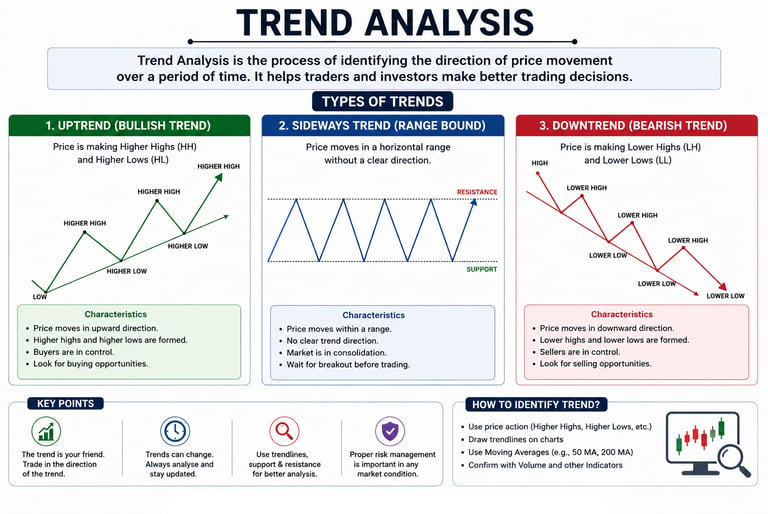
Trend Analysis is the process of studying price movement to determine the dominant direction of the market. It answers a simple but important question:
"Who is currently in control—buyers or sellers?"
Rather than reacting to every price fluctuation, traders analyse the overall movement of the market. By identifying whether price is consistently moving higher, lower, or sideways, they can align their trading decisions with the market instead of fighting against it.
In Price Action trading, trend is identified by observing the sequence of market highs and lows rather than depending solely on technical indicators.
Types of Market Trends
Every financial market moves through three basic phases.
Uptrend
An Uptrend represents a market where buyers dominate. Price continues to create Higher Highs (HH) and Higher Lows (HL), showing that demand remains strong.
During this phase, pullbacks are often viewed as opportunities to join the trend instead of signs that the trend has ended.
Downtrend
A Downtrend forms when sellers control the market. Price creates Lower Highs (LH) and Lower Lows (LL), indicating continuous selling pressure.
Most rallies during a downtrend are temporary and often followed by another move lower.
Sideways Market
A Sideways Market occurs when neither buyers nor sellers have a clear advantage. Price moves between support and resistance without establishing a consistent direction.
During this period, many traders reduce their activity and wait for a confirmed breakout before entering new positions.
Why Trend Analysis Matters
Trend Analysis acts as a market filter.
Instead of taking every trading signal, traders first check whether the setup matches the current market direction. This simple habit can eliminate many low-quality trades.
Trend Analysis also helps traders:
Stay aligned with market momentum.
Avoid buying in weak markets or selling in strong markets.
Improve trade timing during pullbacks.
Build confidence before entering a position.
Prepare for advanced Price Action concepts like BOS, CHOCH, and Trend Reversals.
Following the trend does not guarantee success, but it significantly improves the probability of making better trading decisions.
Practical Example
Suppose a stock has been rising steadily for several weeks, repeatedly making Higher Highs and Higher Lows.
Instead of buying immediately after a strong rally, an experienced trader waits for a temporary pullback. Once the pullback slows down and buyers regain control, the trader enters in the direction of the existing trend.
This approach reduces emotional decisions and allows the trader to trade with market momentum rather than against it.
Common Mistakes
Many beginners struggle with Trend Analysis because they:
Try to predict trend reversals too early.
Trade against a strong trend.
Change their market bias after every small candle.
Ignore the bigger timeframe.
Mistake normal pullbacks for a complete trend change.
Successful traders focus on the overall market direction instead of reacting to every small movement.
Conclusion
Trend Analysis is not about predicting the future—it is about understanding the market's present condition. By identifying whether buyers or sellers are in control, traders can make more logical and disciplined trading decisions.
When combined with Price Action concepts such as Swing Structure, Market Structure, Break of Structure (BOS), and Change of Character (CHOCH), Trend Analysis becomes a powerful tool for reading the market with greater confidence. Learning to trade with the trend, rather than against it, is one of the most valuable habits a trader can develop.
Help
Questions? Reach out anytime.
Contact
Subscribe
+91 6291073274
© 2025. All rights reserved.