Save 20% on all courses!

What is Price Action? A Beginner's Guide to Reading Market Movements
Learn what Price Action is, how it works, why traders use it, and how to read market movements without relying on indicators. A simple beginner-friendly guide with examples.
7/14/20262 min read


What is Price Action?
If you're new to trading, you've probably heard the term Price Action many times. It is one of the most important concepts in technical analysis and forms the foundation of many successful trading strategies.
Unlike methods that depend on several indicators, Price Action focuses only on the movement of price on a chart. By studying how price behaves, traders can understand market direction, identify trading opportunities, and make better decisions.
In this guide, you'll learn what Price Action is, why it matters, and how beginners can start using it effectively.
Price Action Structure :
Price Action follows a logical market structure. Instead of looking at random candles, traders study how the market creates patterns over time.
The basic structure includes:
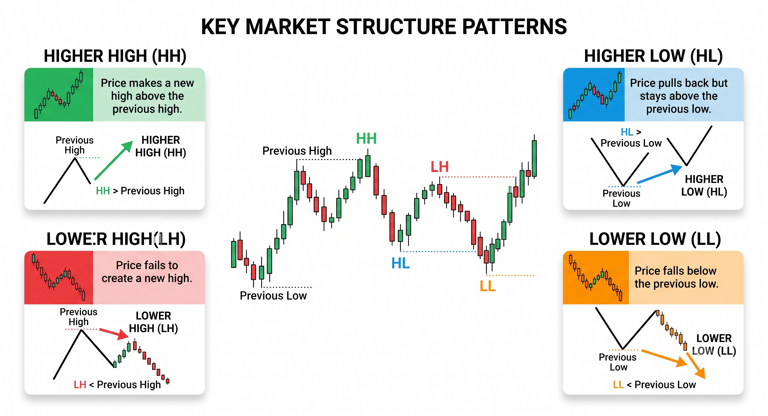
Higher High (HH) – Price makes a new high above the previous high.
Higher Low (HL) – Price pulls back but stays above the previous low.
Lower High (LH) – Price fails to create a new high.
Lower Low (LL) – Price falls below the previous low.
These four movements help traders determine whether the market is in an uptrend, downtrend, or moving sideways.
Understanding market structure is the first step toward learning advanced concepts like Break of Structure (BOS) and Change of Character (CHOCH).
The Psychology Behind Price Action
Price Action follows a logical market structure. Instead of looking at random candles, traders study how the market creates patterns over time.
The basic structure includes:
Higher High (HH) – Price makes a new high above the previous high.
Higher Low (HL) – Price pulls back but stays above the previous low.
Lower High (LH) – Price fails to create a new high.
Lower Low (LL) – Price falls below the previous low.
These four movements help traders determine whether the market is in an uptrend, downtrend, or moving sideways.
Understanding market structure is the first step toward learning advanced concepts like Break of Structure (BOS) and Change of Character (CHOCH).
Imagine a stock has been making a series of Higher Highs (HH) and Higher Lows (HL) over several weeks. This structure shows that buyers continue to push prices higher after every pullback, suggesting a healthy uptrend.
Now imagine the price retraces to a previous support zone instead of continuing straight up. At that level, buyers step in and a strong bullish candlestick forms. Rather than seeing this as a sign of weakness, a Price Action trader views it as evidence that demand is still present.
Because the overall trend remains bullish and support has held successfully, the trader may consider it a potential buying opportunity. The decision is based on how price reacts at an important level—not on a delayed indicator signal.
A Simple Chart Example
Final Thoughts
Price Action is the foundation of technical analysis because every chart pattern, indicator, and trading strategy begins with price itself.
Once you understand how markets create trends, react to support and resistance, and shift between buying and selling pressure, advanced concepts such as Market Structure, Break of Structure (BOS), Change of Character (CHOCH), and Smart Money Concepts (SMC) become much easier to understand.
Like any trading skill, Price Action cannot guarantee profitable trades. It improves your ability to read the market, identify high-probability setups, and make disciplined decisions based on evidence instead of emotion. With consistent practice, it becomes one of the most valuable skills a trader can develop.
Help
Questions? Reach out anytime.
Contact
Subscribe
+91 6291073274
© 2025. All rights reserved.